The article is proudly em-dashed by Claude
Six weeks ago, if you’d asked me what GitHub was, I’d have told you it was something developers use — probably involving code — or perhaps a place where cantankerous old men congregate online to complain about things.
The idea of re-building our website from scratch, with actual code, was something that struck us last week, something we had on our eternal to-do-list, but filed under "procrastination". What Growth Ensemble does now, has evolved from what we were doing 18 months ago, but our website didn't reflect that. The pain point was clear, and our aging Squarespace website was not fit for purpose anymore, but we kept putting it off because it is a time-consuming and expensive process.
Instead of hiring an agency, I used AI as my co-pilot, and went from a conversation to a fully functional, professionally designed website for Growth Ensemble in less than 72 hours. And when I say complete, I mean with our own server, email sign-ups, multi-level navigation, content management system, carousels, contact forms, images, analytics, site crawlers, share functions and a blog complete with author pages, topic filters and CTAs.
It’s built. It’s live. We’re using it - you're on it right now! We're proud of it. Here’s what I learned about the process, what I got wrong, and what it might mean for anyone else considering the same leap.
Use conversation and iteration as your baseline
The honest version of how this worked is that I had conversations. First with my business partner Meredith, then with Chat GTP. The starting point was knowing what we wanted to achieve from the website, and knowing exactly the structure we wanted. I spent the first 45 minutes writing down a desired navigation structure, features we did and didn't want from the site and how we wanted the site to look and feel.
After that I wrote my first prompts, and asked ChatGTP to refine it. This is a process I am sure most LinkedIn AI "experts" also do when they are looking for prompts to sell on their feeds. Importantly, I asked it to refine the prompts to assign roles to be from the perspective of a website designer and developer. I also asked for two different documents to be outputted, a website technical spec plan and a website design and development prompt.
This helped enormously (and was a learning lesson from previous apps) as giving as much context as possible helped make the initial build shorter. Pro-tip - I deliberately avoided asking the site to create images for the site as I wanted to do this later on.
Be more specific early, or it will cost you
My personal brief was “how could I build a new website with the minimum fuss” so planning wasn’t the core goal, but understanding the minutiae of exactly what goes into a website would have saved me a lot of effort down the line.
That 45 minutes I spent planning the site, should have been three or four hours, and a lot more research into technical best practice. That time, invested up front, would have saved an enormous amount of time after the initial build. There are a lot of elements that go into making a website, way more than you'd think. Resolving the "problem statement" side of things is only a small element, its the technical aspect that takes time.
The process re-enforced a core truth we have been consistently finding in the AI building space. Genuine domain expertise + good AI prompts = a great problem solving solution that saves stupid mistakes.
Expect amateur mistakes. Embrace them
As it stands, the website took very little time (v1 was ready within a few hours), I had my own server and was testing within half a day but there were a further 2 days of revisions that could have been drastically cut down.
According to Claude, I made 26 commits in 72 hours, meaning I submitted major code changes to the site, with one third of them avoidable.
These including real amateur mistakes such as:
- Not having social sharing preview images (OG images) — so links looked professional on LinkedIn and WhatsApp.
- Forgetting a favicon — that tiny icon in your browser tab.
- No proper cache revalidation — so content updates didn't appeared immediately.
- Duplicating three commits - meaning I updated the site with exactly the same code three times.
- Building a CMS that didn't have any basic text elements such as italics, bold and different style headers.
- Building classic website "social proof" quadrants, but forgetting to add any icons or images.
Had I spent more time writing a detailed brief before starting — covering layout, spacing, typography, and functional requirements — I could have cut the revision cycle in half. AI is fast, but vague prompts create expensive loops.
So what is the tech stack? And what did it cost?
The site runs on a modern, professional-grade stack that I couldn’t have named six weeks ago. It's because the AI assistant walked me through every element of the set-up, something I could never have done on my own. For the curious, the stack is:
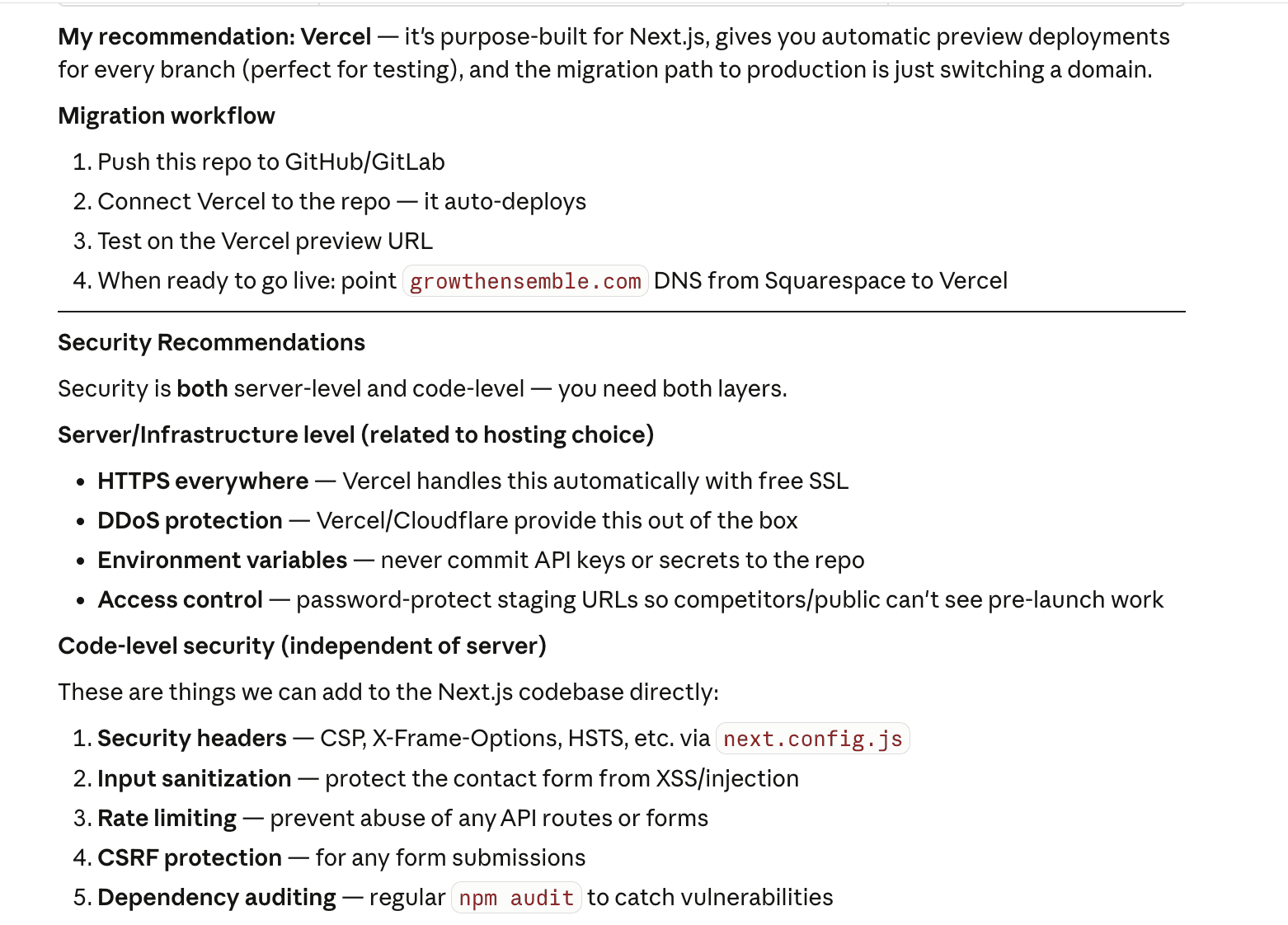
- Next.js (a React framework) — the engine that powers the site
- Vercel — hosting and deployment, with servers in Singapore for our ASEAN audience.
- Resend — email service for contact form submissions.
- Vercel KV — a serverless Redis database powering the CMS
- Google Analytics 4 — tracking and visitor insights.
- GitHub — version control. That thing I didn’t know about six weeks ago.
Total hosting cost: effectively zero on Vercel’s free tier.
The AI subscription I was already paying for, delivered in 3 days. The timeline difference alone is staggering. But the real value is control — I can update anything, anytime, without waiting for a developer or paying change-request fees.
Think about what that would have cost just one year ago. A freelancer to design and build on an existing, templated platform would set you back $5,000–$15,000, and be delivered in 4–8 weeks. I shudder to think what an agency would charge for the same job.
Key Takeaways
The barrier to building professional digital products has collapsed. You don’t need to understand the technology. You need to understand what you want and be able to describe it with precision. The AI handles the rest. That gap between “idea” and “execution” that used to require a development team and a five-figure budget? It’s now a conversation.
I still don’t really know what GitHub does. But my website is live, and it works.
Total Build Cost: AI subscription + 3 days CMO time (plus ongoing tinkering)
Adam Flinter
26 March 2026